
Cheongju Call Bus Driving Change
When Cheongju Call Bus first launched, Demand Responsive Transport (DRT) was still an unfamiliar concept to many people. Today, however, it has become an essential part of Cheongju’s public transportation system.
Since its launch in October 2022, the service has steadily evolved over the past two years. A dedicated operating company was established, and through a major service renewal, its operational model has been continuously improved.
As a result, Cheongju Call Bus has grown into the largest DRT service in Asia based on a single region.
 as of September 30, 2024
Behind the current success of Cheongju Call Bus lies a series of challenges, experiments, and thoughtful decisions. Its journey began in September 2021, when Cheongju City set out to reorganize its public transportation system.
The process, however, was not as simple as expected. While adjustments were relatively smooth in high-demand urban areas, the situation was quite different in rural towns and villages.
In these areas, lower demand made it inefficient to operate traditional fixed bus routes. At the same time, simply reducing or eliminating routes would have caused significant inconvenience for residents who rely heavily on public transportation.
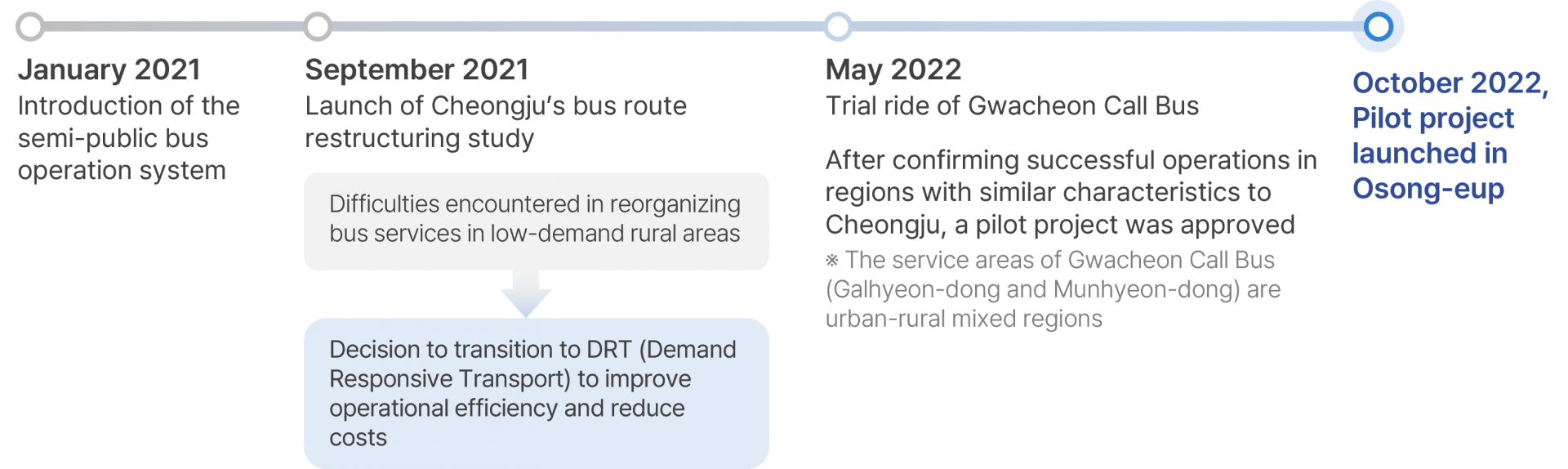
In this situation, the alternative that emerged was Demand Responsive Transport (DRT). As the name suggests, DRT is a system where buses operate based on actual demand. Instead of following fixed routes and schedules, services run flexibly in response to user requests.
In May 2022, Cheongju City carefully reviewed the introduction of DRT by visiting Gwacheon, a city with similar characteristics, to examine a successful operational case. The service area of Gwacheon Call Bus was an urban-rural mixed region, much like the areas being considered for Cheongju Call Bus.
Through this review, the city confirmed that, under the right conditions, DRT could be successfully implemented and sustained. Finally, in October 2022, Cheongju launched its pilot project in Osong-eup.
Cheongju Call Bus Begins Its Next Leap Forward
Starting in Osong-eup, Cheongju Call Bus gradually expanded to more regions. After the pilot project was successfully completed, Cheongju City decided to scale it into a full-service operation. In June 2023, Cheongju Call Bus officially launched, with services opening sequentially across multiple rural areas.
Building on the success of the Osong-eup pilot, Cheongju’s public bus system began transitioning step by step. The approach shifted toward providing customized mobility services based on an analysis of residents’ daily living patterns.
In particular, instead of operating each area independently, two or more 읍·면 were integrated into a single service zone to maximize efficiency. Prior to implementation, simulations were conducted to identify the most effective operational model.
As Cheongju Call Bus continues to expand, it is bringing meaningful changes to each region. Even though the same DRT system is applied, each area has different characteristics and travel patterns, leading to slightly different outcomes. Let’s take a closer look at key indicators in Osong-eup, Gangnae-myeon, and Hyeondo-myeon.
① Hyeondo-myeon Becomes Smarter with AI-Based Public Transportation
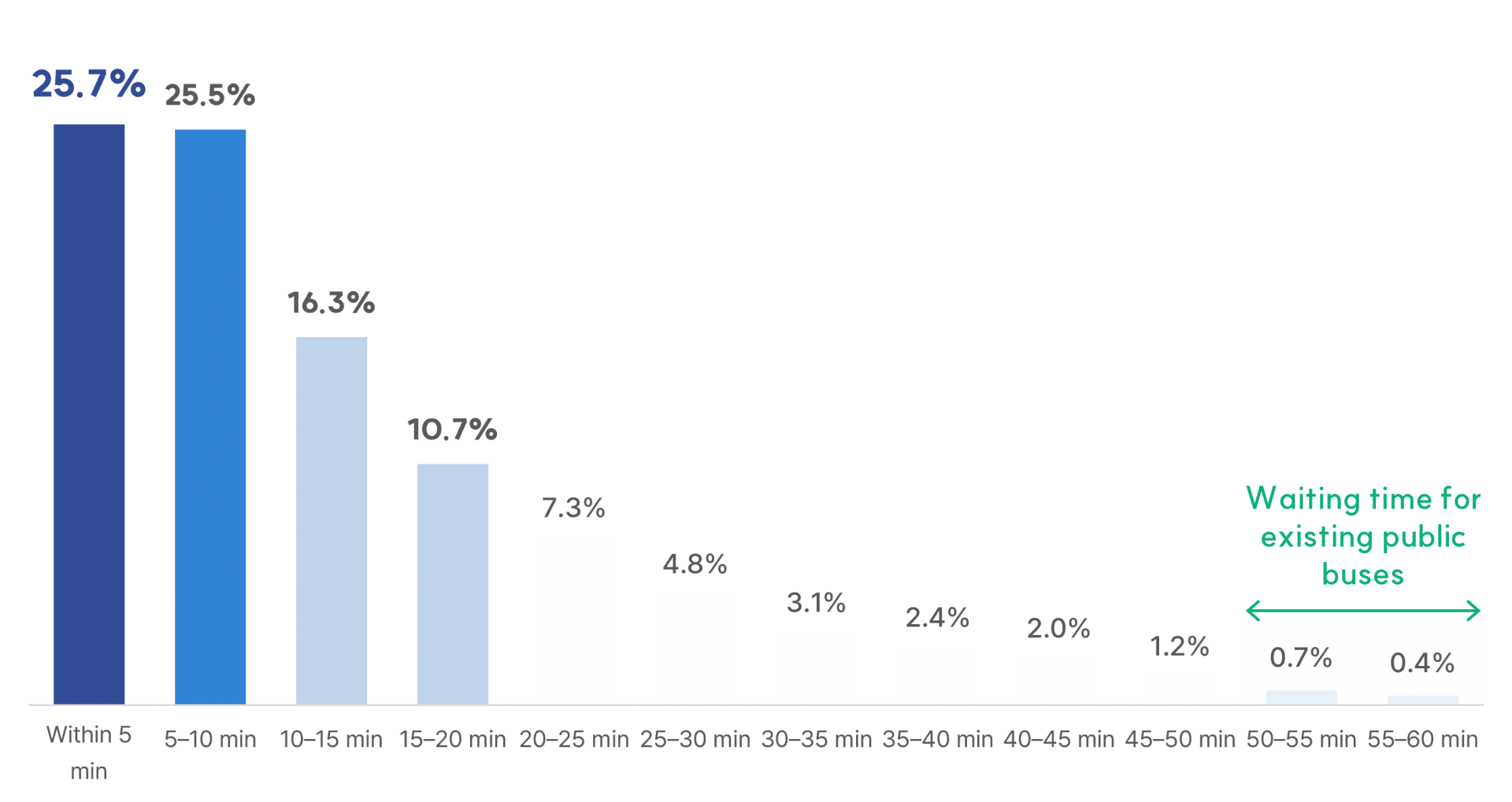
Cheongju Call Bus is evolving beyond a simple mode of transport into a more efficient, AI-powered public mobility service. In Hyeondo-myeon, in particular, it has significantly reduced long waiting times, greatly improving convenience for residents.
In the past, passengers often had to wait over 60 minutes on average to catch a bus. Now, with Cheongju Call Bus, 26% of users are matched with a vehicle within 5 minutes, and 78% within 20 minutes. Additionally, 90% of users receive service within 30 minutes of making a request, eliminating the inconvenience of long waiting times.
With the help of an AI-based system, vehicle dispatch is adjusted in real time, and arrival information is provided in advance, making the service much more predictable. Not only are users informed of when they can board, but they are also given estimated arrival times at their destination, allowing for more efficient and reliable trip planning.
② Gangnae-myeon: Balanced Demand Throughout the Day
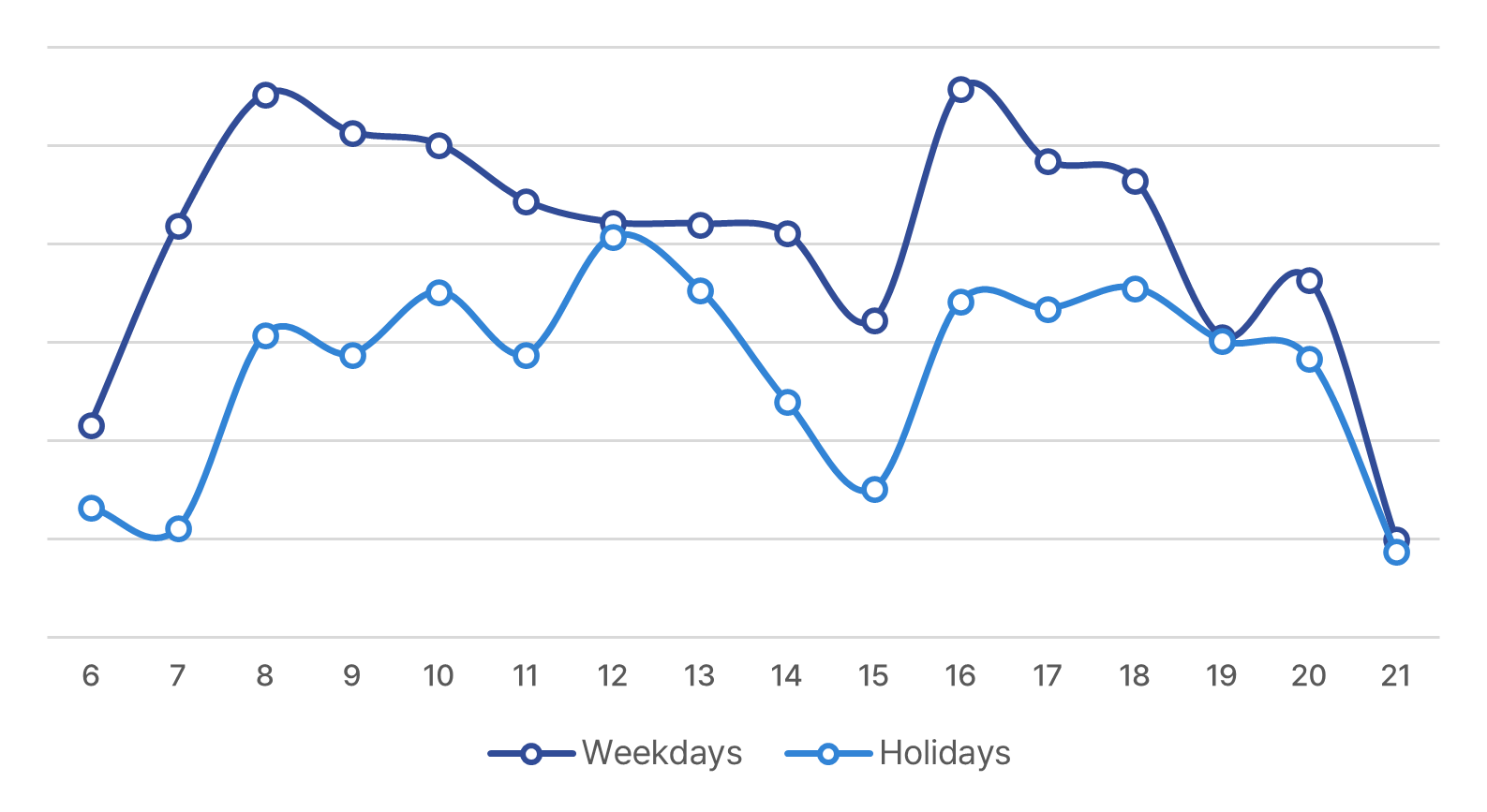
Each region where Cheongju Call Bus operates shows slightly different usage patterns. In Gangnae-myeon, demand is evenly distributed throughout the day rather than being concentrated at specific times.
There are also noticeable differences by age group. Teenagers tend to use the service most during school commute hours—around 7 AM and 4 PM—while adults show peak usage during the morning commute at around 8 AM. Outside of these peak times, demand remains relatively balanced from 8 AM to 7 PM (with the exception of around 3 PM).
This pattern can be attributed to the presence of an industrial complex and a university in Gangnae-myeon, which serve as major travel destinations and shape the mobility needs of both younger and working-age populations. As a result, instead of demand being concentrated at certain hours, Gangnae-myeon maintains steady usage throughout the day, enabling more stable and efficient service operations.
③ Osong-eup: Continuous Growth with Stable Operations
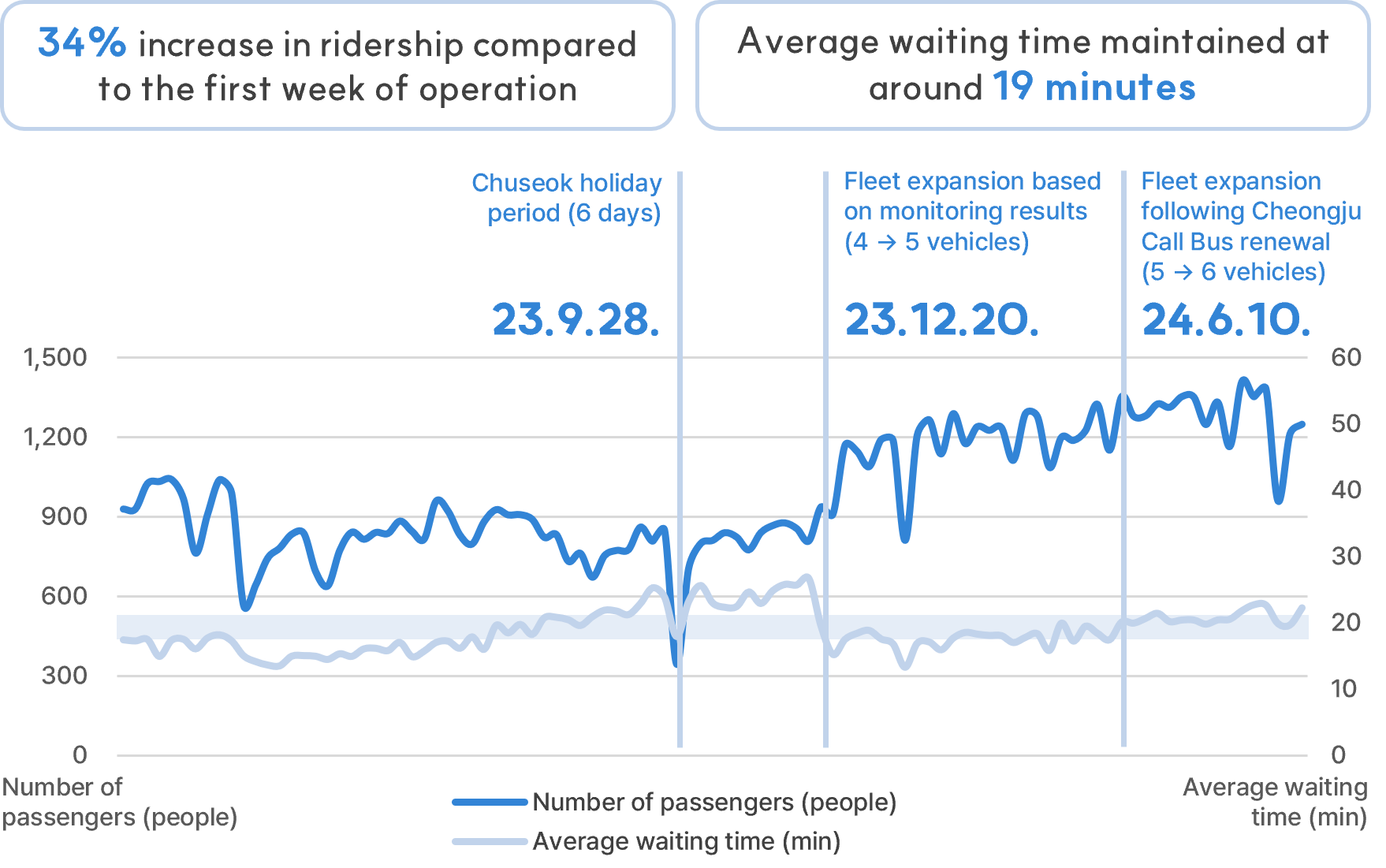
The number of passengers using Cheongju Call Bus in Osong-eup continues to grow steadily. Currently, around 170 to 180 people use the service daily on average—an increase of 34% compared to 132 passengers per day during the first week of operation.
What’s particularly impressive is that, despite this increase in ridership, the average waiting time has remained stable at around 19 minutes. This level of efficiency is made possible by TAMOS, a simulation-based analysis program. Through thorough pre-analysis, the dispatch system was carefully designed, allowing the service to handle growing demand without increasing wait times.
In addition, Cheongju Call Bus continuously monitors usage data to proactively identify and resolve potential issues. For example, when demand in Osong-eup approached the limits of transport capacity, data analysis led to the decision to add more vehicles. This helped resolve capacity constraints while maintaining the upward trend in ridership.
In Osong-eup, the key strength lies not only in high usage but also in the combination of continuous data analysis and optimized operations, which together create a more convenient and reliable public transportation system.
Want to learn more about Cheongju Call Bus?
Check out the 2024 Q3 VARO Mobility Magazine 📖


Cheongju Call Bus Driving Change
When Cheongju Call Bus first launched, Demand Responsive Transport (DRT) was still an unfamiliar concept to many people. Today, however, it has become an essential part of Cheongju’s public transportation system.
Since its launch in October 2022, the service has steadily evolved over the past two years. A dedicated operating company was established, and through a major service renewal, its operational model has been continuously improved.
As a result, Cheongju Call Bus has grown into the largest DRT service in Asia based on a single region.
Behind the current success of Cheongju Call Bus lies a series of challenges, experiments, and thoughtful decisions. Its journey began in September 2021, when Cheongju City set out to reorganize its public transportation system.
The process, however, was not as simple as expected. While adjustments were relatively smooth in high-demand urban areas, the situation was quite different in rural towns and villages.
In these areas, lower demand made it inefficient to operate traditional fixed bus routes. At the same time, simply reducing or eliminating routes would have caused significant inconvenience for residents who rely heavily on public transportation.
In this situation, the alternative that emerged was Demand Responsive Transport (DRT). As the name suggests, DRT is a system where buses operate based on actual demand. Instead of following fixed routes and schedules, services run flexibly in response to user requests.
In May 2022, Cheongju City carefully reviewed the introduction of DRT by visiting Gwacheon, a city with similar characteristics, to examine a successful operational case. The service area of Gwacheon Call Bus was an urban-rural mixed region, much like the areas being considered for Cheongju Call Bus.
Through this review, the city confirmed that, under the right conditions, DRT could be successfully implemented and sustained. Finally, in October 2022, Cheongju launched its pilot project in Osong-eup.
Cheongju Call Bus Begins Its Next Leap Forward
Starting in Osong-eup, Cheongju Call Bus gradually expanded to more regions. After the pilot project was successfully completed, Cheongju City decided to scale it into a full-service operation. In June 2023, Cheongju Call Bus officially launched, with services opening sequentially across multiple rural areas.
Building on the success of the Osong-eup pilot, Cheongju’s public bus system began transitioning step by step. The approach shifted toward providing customized mobility services based on an analysis of residents’ daily living patterns.
In particular, instead of operating each area independently, two or more 읍·면 were integrated into a single service zone to maximize efficiency. Prior to implementation, simulations were conducted to identify the most effective operational model.
As Cheongju Call Bus continues to expand, it is bringing meaningful changes to each region. Even though the same DRT system is applied, each area has different characteristics and travel patterns, leading to slightly different outcomes. Let’s take a closer look at key indicators in Osong-eup, Gangnae-myeon, and Hyeondo-myeon.
① Hyeondo-myeon Becomes Smarter with AI-Based Public Transportation
Cheongju Call Bus is evolving beyond a simple mode of transport into a more efficient, AI-powered public mobility service. In Hyeondo-myeon, in particular, it has significantly reduced long waiting times, greatly improving convenience for residents.
In the past, passengers often had to wait over 60 minutes on average to catch a bus. Now, with Cheongju Call Bus, 26% of users are matched with a vehicle within 5 minutes, and 78% within 20 minutes. Additionally, 90% of users receive service within 30 minutes of making a request, eliminating the inconvenience of long waiting times.
With the help of an AI-based system, vehicle dispatch is adjusted in real time, and arrival information is provided in advance, making the service much more predictable. Not only are users informed of when they can board, but they are also given estimated arrival times at their destination, allowing for more efficient and reliable trip planning.
② Gangnae-myeon: Balanced Demand Throughout the Day
Each region where Cheongju Call Bus operates shows slightly different usage patterns. In Gangnae-myeon, demand is evenly distributed throughout the day rather than being concentrated at specific times.
There are also noticeable differences by age group. Teenagers tend to use the service most during school commute hours—around 7 AM and 4 PM—while adults show peak usage during the morning commute at around 8 AM. Outside of these peak times, demand remains relatively balanced from 8 AM to 7 PM (with the exception of around 3 PM).
This pattern can be attributed to the presence of an industrial complex and a university in Gangnae-myeon, which serve as major travel destinations and shape the mobility needs of both younger and working-age populations. As a result, instead of demand being concentrated at certain hours, Gangnae-myeon maintains steady usage throughout the day, enabling more stable and efficient service operations.
③ Osong-eup: Continuous Growth with Stable Operations
The number of passengers using Cheongju Call Bus in Osong-eup continues to grow steadily. Currently, around 170 to 180 people use the service daily on average—an increase of 34% compared to 132 passengers per day during the first week of operation.
What’s particularly impressive is that, despite this increase in ridership, the average waiting time has remained stable at around 19 minutes. This level of efficiency is made possible by TAMOS, a simulation-based analysis program. Through thorough pre-analysis, the dispatch system was carefully designed, allowing the service to handle growing demand without increasing wait times.
In addition, Cheongju Call Bus continuously monitors usage data to proactively identify and resolve potential issues. For example, when demand in Osong-eup approached the limits of transport capacity, data analysis led to the decision to add more vehicles. This helped resolve capacity constraints while maintaining the upward trend in ridership.
In Osong-eup, the key strength lies not only in high usage but also in the combination of continuous data analysis and optimized operations, which together create a more convenient and reliable public transportation system.
Want to learn more about Cheongju Call Bus?
Check out the 2024 Q3 VARO Mobility Magazine 📖