Hello from Studio G!
The Korean Society for Railway and Studio Galilei jointly hosted the Rural Mobility Forum (RMF) Seminar on July 10 at the Kim Man-deok Memorial Hall in Jeju.
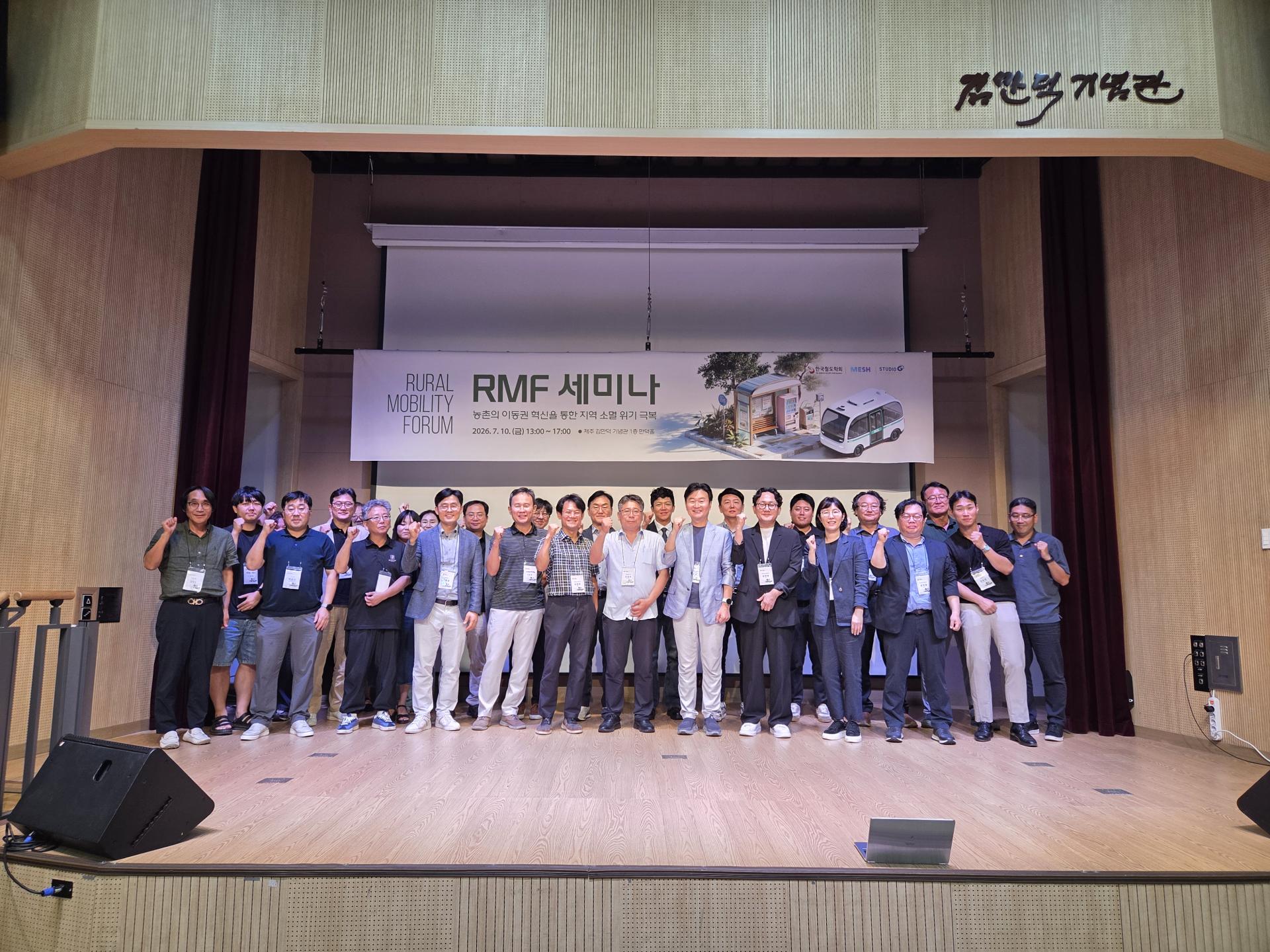
RMF(Rural Mobility Forum) Seminar
Held under the theme “Sustainable Rural Mobility in an Era of Population Decline,” the seminar brought together representatives from central and local governments, research institutes, academia, private companies, and investment organizations.
Rather than viewing mobility challenges in rural, farming, and fishing communities simply as a shortage of transportation options, participants discussed them as a broader issue affecting access to healthcare, welfare, education, and other essential parts of everyday life.
The seminar explored ways to place mobility at the center of regional development by connecting it with welfare, logistics, tourism, and the local economy. Participants also shared ideas on how policy, technology, and industry can work together to build sustainable living environments in communities facing population decline.
🌿 Exploring Everyday Challenges Through the Lens of Mobility
The event opened with remarks from Lee Jun, President of the Korean Society for Railway, followed by a welcome address from Kim Kyung-beom, Chair of the Society’s Jeju Branch.
The presentations covered a range of real-life challenges facing rural communities, including food-related care and access to essential groceries in an aging society, stronger connections between railways and local transportation, and the long-term sustainability of public mobility services in areas experiencing population decline.
Professor Lim Hee-sook of Kyung Hee University emphasized the need to design transportation services together with essential services such as healthcare, welfare, and food support.
Choi Jin-gu, Manager at SYSTRA France, presented examples from France’s regional transportation systems and discussed how rail and local transportation can be connected more effectively. Dr. Lim Seo-hyun of the Korea Transport Institute outlined policy priorities for making public mobility services more sustainable in population-declining regions.
These discussions highlighted an important point: mobility challenges cannot be fully addressed unless transportation services connect residents with hospitals, markets, welfare facilities, and other essential destinations. In this sense, the seminar expanded the conversation from the right to mobility to the broader ability to maintain everyday life within the community.
🚌 Connecting DRT and Community Hubs in a Regional Operating Model
The policy and public service discussions were followed by practical models that could be applied in real communities.
Baek Bareum, Executive Director and Head of the DRT Business Division at Studio Galilei, introduced a regional operating model that connects Demand Responsive Transport (DRT), Community Hubs, electric vehicle charging infrastructure, and partnerships with local transportation operators.
He also shared operational experience and demonstration cases developed across 42 service areas nationwide, involving 166 vehicles and more than 3.08 million cumulative passenger rides. These examples illustrated the importance of operating mobility services in ways that reflect the different conditions and travel needs of each community.
Unlike conventional public transportation that follows fixed routes and timetables, DRT can flexibly adjust vehicles and routes based on passenger requests and local demand.
When combined with Community Hubs that provide everyday services and charging infrastructure, DRT can go beyond supporting transportation and become part of a broader local foundation for daily life.
🏘️ Using Mobility as a Foundation for Regional Revitalization
Choi Da-eun, Team Leader of the Innovation Strategy Office at Studio Galilei, presented a vision for creating new local hubs by connecting mobility services with culture, tourism, everyday services, and community activities.
The presentation looked beyond mobility as a way of simply moving people from one destination to another. Instead, it explored how the journeys of residents and visitors could be connected with local spending, longer stays, and cultural experiences to create new value and economic activity within the region.
Designing mobility and local infrastructure together could help visitors travel more easily between local attractions while giving residents better access to the services they need. This approach could also bring renewed vitality to regions experiencing population decline.
The presentation showed how mobility can move beyond solving transportation problems and become an essential foundation for regional revitalization.
🤝 Building Sustainable Communities Through Policy, Technology, and Investment
The seminar also explored the investment and logistics systems needed to support these regional operating models.
Lim Jong-soo, Senior Director at MYSC, discussed the role of impact investment in addressing population decline. Kim Young-joo, Department Head at the Korea Railroad Research Institute, introduced a future-oriented regional service model that combines public transportation with logistics.
The panel discussion that followed examined ways to strengthen cooperation among institutions and develop public mobility services suited to the conditions of individual communities.
The RMF Seminar was especially meaningful because it approached rural mobility not simply as a matter of supplying additional transportation, but as part of a regional operating model that brings together AI-powered mobility, welfare, logistics, tourism, and investment.
Participants agreed that sustainable local ecosystems require transportation services and the region’s social and economic infrastructure to be designed together from the beginning.
The Korean Society for Railway and Studio Galilei plan to develop RMF into a platform for policy and industry collaboration in rural mobility. They will also expand AI-powered regional operating platforms and public mobility demonstration projects while continuing policy research and cooperation among industry, academia, research institutions, and government.
Studio Galilei will continue looking closely at the different mobility environments and living conditions of each community as we develop sustainable solutions that connect residents’ journeys, everyday lives, and new opportunities for their regions.
Read the full article ①
Read the full article ②


Hello from Studio G!
The Korean Society for Railway and Studio Galilei jointly hosted the Rural Mobility Forum (RMF) Seminar on July 10 at the Kim Man-deok Memorial Hall in Jeju.
RMF(Rural Mobility Forum) Seminar
Held under the theme “Sustainable Rural Mobility in an Era of Population Decline,” the seminar brought together representatives from central and local governments, research institutes, academia, private companies, and investment organizations.
Rather than viewing mobility challenges in rural, farming, and fishing communities simply as a shortage of transportation options, participants discussed them as a broader issue affecting access to healthcare, welfare, education, and other essential parts of everyday life.
The seminar explored ways to place mobility at the center of regional development by connecting it with welfare, logistics, tourism, and the local economy. Participants also shared ideas on how policy, technology, and industry can work together to build sustainable living environments in communities facing population decline.
🌿 Exploring Everyday Challenges Through the Lens of Mobility
The event opened with remarks from Lee Jun, President of the Korean Society for Railway, followed by a welcome address from Kim Kyung-beom, Chair of the Society’s Jeju Branch.
The presentations covered a range of real-life challenges facing rural communities, including food-related care and access to essential groceries in an aging society, stronger connections between railways and local transportation, and the long-term sustainability of public mobility services in areas experiencing population decline.
Professor Lim Hee-sook of Kyung Hee University emphasized the need to design transportation services together with essential services such as healthcare, welfare, and food support.
Choi Jin-gu, Manager at SYSTRA France, presented examples from France’s regional transportation systems and discussed how rail and local transportation can be connected more effectively. Dr. Lim Seo-hyun of the Korea Transport Institute outlined policy priorities for making public mobility services more sustainable in population-declining regions.
These discussions highlighted an important point: mobility challenges cannot be fully addressed unless transportation services connect residents with hospitals, markets, welfare facilities, and other essential destinations. In this sense, the seminar expanded the conversation from the right to mobility to the broader ability to maintain everyday life within the community.
🚌 Connecting DRT and Community Hubs in a Regional Operating Model
The policy and public service discussions were followed by practical models that could be applied in real communities.
Baek Bareum, Executive Director and Head of the DRT Business Division at Studio Galilei, introduced a regional operating model that connects Demand Responsive Transport (DRT), Community Hubs, electric vehicle charging infrastructure, and partnerships with local transportation operators.
He also shared operational experience and demonstration cases developed across 42 service areas nationwide, involving 166 vehicles and more than 3.08 million cumulative passenger rides. These examples illustrated the importance of operating mobility services in ways that reflect the different conditions and travel needs of each community.
Unlike conventional public transportation that follows fixed routes and timetables, DRT can flexibly adjust vehicles and routes based on passenger requests and local demand.
When combined with Community Hubs that provide everyday services and charging infrastructure, DRT can go beyond supporting transportation and become part of a broader local foundation for daily life.
🏘️ Using Mobility as a Foundation for Regional Revitalization
Choi Da-eun, Team Leader of the Innovation Strategy Office at Studio Galilei, presented a vision for creating new local hubs by connecting mobility services with culture, tourism, everyday services, and community activities.
The presentation looked beyond mobility as a way of simply moving people from one destination to another. Instead, it explored how the journeys of residents and visitors could be connected with local spending, longer stays, and cultural experiences to create new value and economic activity within the region.
Designing mobility and local infrastructure together could help visitors travel more easily between local attractions while giving residents better access to the services they need. This approach could also bring renewed vitality to regions experiencing population decline.
The presentation showed how mobility can move beyond solving transportation problems and become an essential foundation for regional revitalization.
🤝 Building Sustainable Communities Through Policy, Technology, and Investment
The seminar also explored the investment and logistics systems needed to support these regional operating models.
Lim Jong-soo, Senior Director at MYSC, discussed the role of impact investment in addressing population decline. Kim Young-joo, Department Head at the Korea Railroad Research Institute, introduced a future-oriented regional service model that combines public transportation with logistics.
The panel discussion that followed examined ways to strengthen cooperation among institutions and develop public mobility services suited to the conditions of individual communities.
The RMF Seminar was especially meaningful because it approached rural mobility not simply as a matter of supplying additional transportation, but as part of a regional operating model that brings together AI-powered mobility, welfare, logistics, tourism, and investment.
Participants agreed that sustainable local ecosystems require transportation services and the region’s social and economic infrastructure to be designed together from the beginning.
The Korean Society for Railway and Studio Galilei plan to develop RMF into a platform for policy and industry collaboration in rural mobility. They will also expand AI-powered regional operating platforms and public mobility demonstration projects while continuing policy research and cooperation among industry, academia, research institutions, and government.
Studio Galilei will continue looking closely at the different mobility environments and living conditions of each community as we develop sustainable solutions that connect residents’ journeys, everyday lives, and new opportunities for their regions.
Read the full article ①
Read the full article ②